
AI in Industry: Connecting Classroom Learning with Workforce Expectations
(October 29, 2026) - On October 14, 2026, Clayton State University’s Center for Excellence in Learning and Teaching (CELT) and Career and Professional Services collaborated to host an AI in Industry Panel Discussion. Led by Martha Fairley, Executive Director of CELT, and Bridgette McDonald, Executive Director of Career and Professional Services, the event brought together Clayton State faculty, a student entrepreneur, and industry experts to explore AI’s impact on teaching, learning, and workforce readiness.
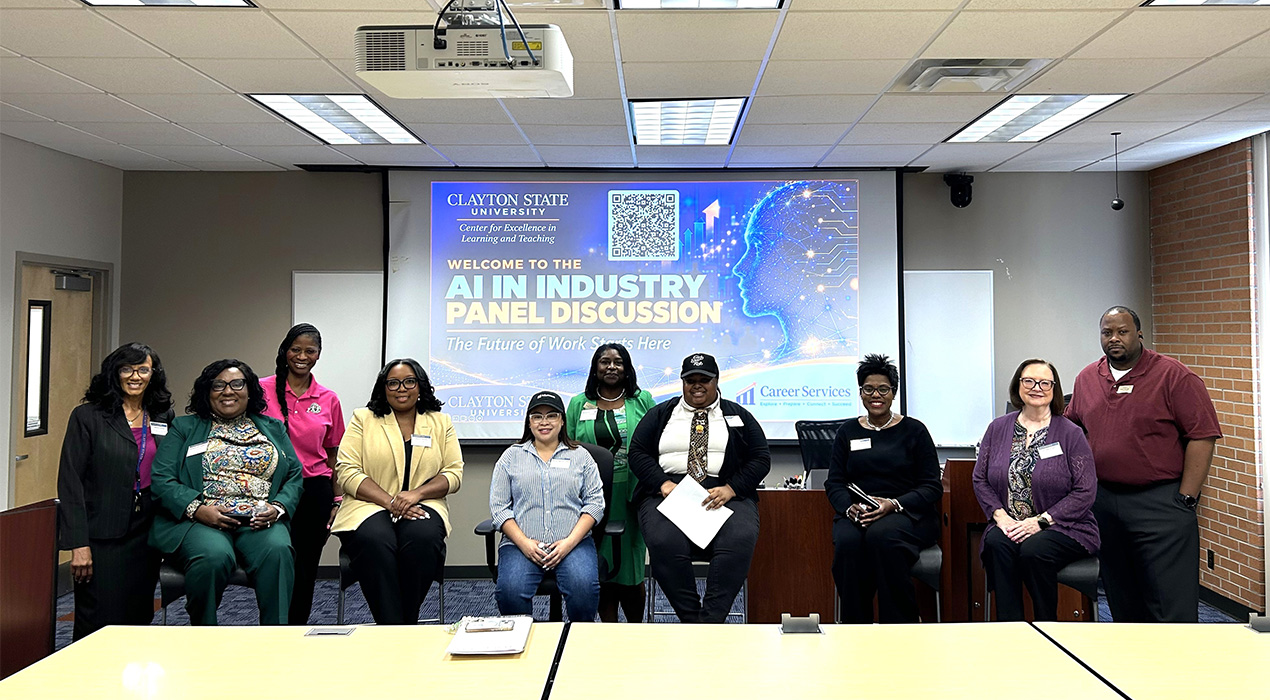
Martha Fairley moderated the panel and opened the discussion by outlining its goal: to explore how AI is changing the workplace and what those changes mean for preparing Clayton State graduates. Through a guided Q&A, panelists examined the skills employers value, shifting workplace expectations, responsible AI use, and the continued importance of critical thinking and human expertise. The discussion connected classroom learning with workplace needs and experiences, offering practical next steps for students, opportunities for faculty to strengthen classroom learning, and ways employers can partner with the university to prepare graduates for an AI-enabled workforce.
Panel Speakers and Discussion Highlights
Nancy Nguyen | Senior Account Executive, Microsoft
Nguyen earned both her bachelor’s and master’s degrees from Clayton State University. At Microsoft, she helps executive leaders use AI to modernize operations, shape AI strategy, and support responsible workforce transformation.
Nguyen explained that organizations are looking to AI to improve performance, reduce costs, and streamline operations. In her own work, AI helps accelerate consulting research and retrieve current customer information, allowing her to spend more time addressing organizational needs. She emphasized that effective use begins with understanding the organization and communicating clearly with the technology.
“A lot has to do with understanding how to communicate with AI, the technology, and the prompting,” Nguyen said.
Latangela Hill | Human Resources Director, City of McDonough, Georgia
Hill brings nearly 30 years of experience in human resources, public service, and organizational leadership. She holds a master’s degree in human resources and is a registered mediator and HR consultant.
Drawing on her public-sector experience, Hill emphasized the importance of human judgment, empathy, and accountability when using AI. She also discussed the care she takes with information entered into AI tools, given her agency’s public-records responsibilities.
“As the human being that's responsible for inputting information and receiving information, I'm accountable,” Hill said. “So that's the takeaway that I would like graduates to understand.”
Matika Holmes | Assistant Director of Student Services, South College
Holmes is pursuing her doctorate at the University of Louisiana at Lafayette and serves on the Clayton State University Alumni Association Board of Advisors.
Drawing on her experience in Student Services, Holmes discussed how AI can support organizing information, drafting communications, and streamlining administrative tasks. She emphasized the importance of professional judgment, reviewing AI-generated content for accuracy, and protecting confidential information.
Her perspective highlighted AI as a tool to support thoughtful, efficient work while keeping human oversight and responsibility central to the process.
Dr. Joie S. Hain | Associate Professor of Marketing, Clayton State University
Hain teaches graduate and undergraduate courses in digital marketing, social media marketing, and professional selling. In 2026, she received Clayton State University’s Alice J. Smith Award, the university’s highest faculty award. In 2025, she was a State of Georgia Governor’s Teaching Fellow with a concentration in artificial intelligence.
Hain emphasized that educators must understand students’ existing AI knowledge and prepare them to think beyond individual tools. As AI education expands in K–12 settings, she encouraged universities to consider how their teaching will meet students’ evolving needs.
“Are we just teaching tools or are we teaching strategy?” Hain asked. “Because tools come and go, but we have to understand how AI works from a strategic perspective.”
Leah Brunson | Elementary Education Student, CELT Student Assistant; CEO and President, STEAM Girls Rock Incorporated
Brunson is a second-semester junior pursuing a degree in elementary education at Clayton State University. She also serves as the student assistant in the Center for Excellence in Learning and Teaching and leads STEAM Girls Rock Incorporated.
Brunson described using ChatGPT as a planning partner to explore event timing, budgets, workshop ideas, and team communications. Her experience offered a student entrepreneur’s perspective on using AI to organize ideas and support decision-making.
She also emphasized the importance of reviewing AI-generated content such as emails, before using it. “Don't just skim it, but change it if it needs to be changed,” Brunson said.
Shar’ron W. Russell, MBA | Manager, Data Center Power Strategy, Prologis
Russell brings more than 25 years of electric utility experience. She supports large-scale data center development through site selection, energy procurement, and utility interconnection strategy across major U.S. markets.
“Using AI provides increased efficiency as well as increased access to knowledge,” Russell said.
She emphasized that useful results depend on how users structure their prompts. Russell also highlighted the need for people to bring empathy, context, and clear boundaries to their use of AI, reinforcing the importance of human expertise in professional decision-making.
Across the discussion, panelists emphasized that preparing for an AI-enabled workforce requires more than knowing how to use the latest tools. It also requires critical thinking, sound judgment, responsible decision-making, and the ability to connect knowledge with practice. By bringing employer, faculty, and student perspectives into the same conversation, CELT and Career and Professional Services highlighted a shared responsibility: helping Clayton State graduates use AI effectively while contributing the human expertise their professions require.