
Black History Month Faculty Spotlight: Author and Clayton State Professor Dr. Kenja McCray
(February 19, 2026) - What started as a research paper quietly grew into a book that would reshape how parts of Black Power history are understood and change the life of the Clayton State University professor who wrote it. Dr. Kenja McCray, author of “Essential Soldiers: Women Activists and Black Power Leadership,” shared her writer’s journey with us just in time for Black History month.
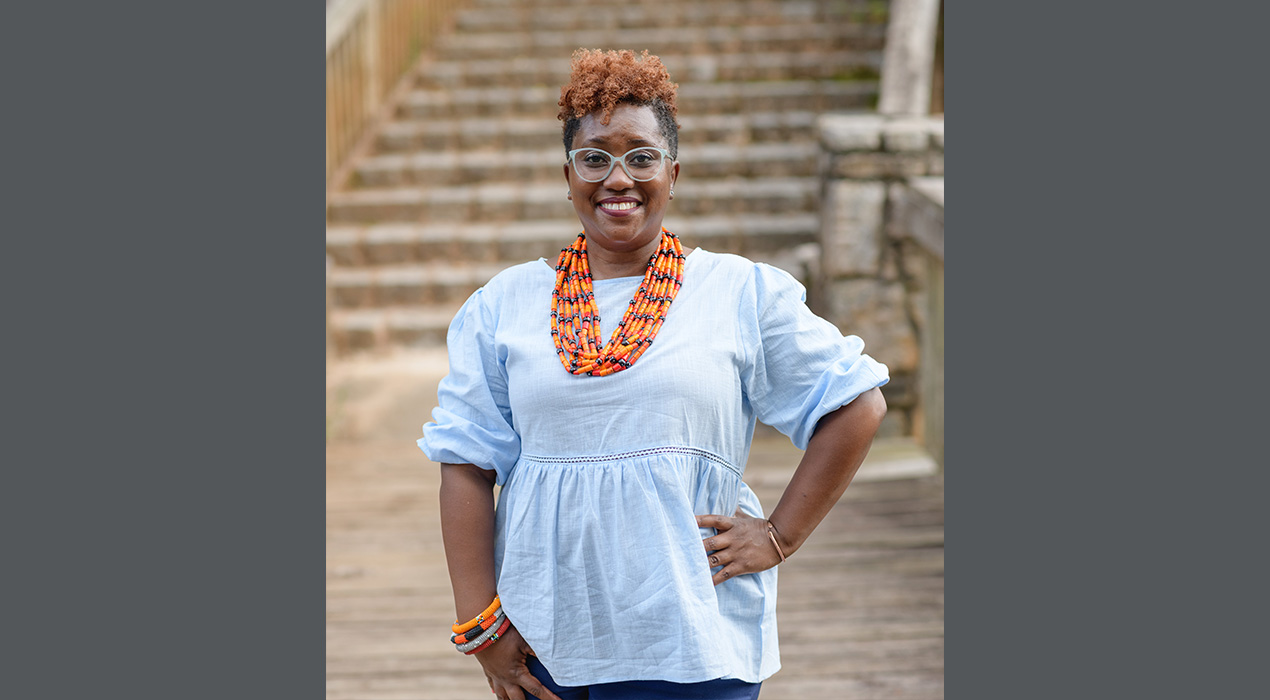
Dr. McCray didn’t set out to write a book. At the time, she was a graduate student working on a paper for a doctoral course on African American social movements. The assignment sent her into a research library, where she asked a specialty librarian for sources on women in the Black Power movement. What came back surprised her. “The books were almost all about the Black Panther Party,” Dr. McCray said.
Her research experiences revealed something important: even in academic spaces, Black
Power was often treated as a synonym for male leadership and associated with a single
organization. Dr. McCray knew women had been involved across the movement, but their
stories weren’t easy to find. At that moment in the library, a seed was planted, but
it was her professor who helped it grow.
Dr. McCray’s instructor, a scholar-activist who had lived through the era she was
studying, encouraged her to explore women involved in organizations that were guided
by Kawaida, the African-centered cultural philosophy that gave rise to Kwanzaa. When
Dr. McCray shared her interest in oral history, he connected her to women who might
be willing to share their experiences.
“He basically told me, ‘Tell them I sent you,’” she said. Those introductions led
to more names, more phone calls, and eventually more trust. One interview turned into
another, then another. Some people were hesitant at first, shaped by years of government
surveillance and internal conflict during the movement. Many didn’t see themselves
as leaders at all. But as Dr. McCray listened, a different picture emerged. Female
activists kept organizations running when male leaders were under attack. Women edited
newspapers, ran schools, organized food programs, taught children, and held communities
together, often while raising families. They rarely claimed credit, but others remembered
what they had done. They did not lead from podiums. In many cases, they didn’t have
formal titles. They led by making sure the work got done.
One of those women was Martha Bright of the East Organization in New York City. She recalled taking on a wide range of responsibilities during her time with Black News, a community newspaper in the Bedford-Stuyvesant neighborhood. She wrote, edited, and proofread stories, often joining other women on trips to conduct original, on the ground reporting. She emphasized that female staff members played substantial roles in producing the publication. Bright described the paper as a hands-on operation in which the East “sisters” were deeply involved.
Despite their significant contributions, women rarely held Black News’s top formal leadership positions. While some women served on governing boards, men
generally occupied the highest titled roles; and all four individuals who officially
served as editor between 1969 and 1984 were men. Interviews like that of a former
East school student named Akili Walker told a different story. Walker remembered
Bright as being “in charge”
of the newspaper, highlighting how women’s labor and informal leadership could be
recognized within Kawaida influenced organizations, even when such authority was not
reflected in official titles.
Another figure was Tayari kwa Salaam, a co-founder of Ahidiana, a Kawaida-influenced
organization in New Orleans. Salaam helped build a community-centered school designed
to give Black children a culturally grounded education at a time when desegregation
had failed to address deeper forms of racial and cultural harm. She developed a curriculum,
shaped educational philosophy, and helped redefine how leadership could operate within
nationalist movements through teaching and nurturing.
“She stood out to me because the women were supposed to be in traditional secondary roles, not philosophers. They weren’t supposed to be the leaders, the thought makers, in terms of the philosophies of the organizations in the movement, but she did it,” Dr. McCray said. Salaam wrote “Working Together, We Can Make a Change” in 1980. She declared in the booklet that women were “essential soldiers” in the fight for both Black freedom and women’s liberation. For McCray, that response captured the essence of what her research was uncovering.
Then there was Subira Kifano, a member of the Kawaida Groundwork Committee and the Organization Us in Los Angeles. She began in the mid-1970s by insisting that children needed care and education during organizational meetings. That insistence grew into structured childcare, then curriculum development, and eventually into the founding of the Mary McLeod Bethune Institute in South Central Los Angeles in 1979. The school served not just families in the organization but also the broader community, offering after-school, weekend, and summer programs centered on Black history, culture, and self-worth.
Kifano later became a co-chair of the reconstituted version of the former Us Organization
and served as a bridge between Black nationalist groups and other community organizations,
including the National Association of Black Women. Her leadership extended far beyond
formal titles, shaping institutions that outlasted the movement itself.
None of these women fit the dominant image of Black Power leadership. They were not
authoritarian, top-down, or self-promoting. They did not always see themselves as
leaders. Yet their work, such as feeding people, educating children, publishing newspapers,
and sustaining organizations, made everything else possible.
Dr. McCray ultimately conducted about 30 interviews, building an informal oral history archive that was centered on a form of leadership rarely highlighted: servant leadership rooted in care, responsibility, and persistence. That oral history stockpile became the backbone of her dissertation. Years later, after extensive revisions, peer review, and more patience than she ever expected, it was published as an academic book.
Along the way, Dr. McCray says the process changed her in ways she didn’t anticipate. “Writing a peer-reviewed book is a long, exhausting process,” she said. “I didn’t think I could do it. I really didn’t.” Finishing the project forced her to develop endurance, discipline, and self-confidence. When the book was finally published, it reshaped how she viewed her own limits. “If I could do this,” she said, “I realized I could do anything I set my mind to.”
That lesson now shapes how she works with students at Clayton State University. As a professor and mentor, she draws directly from her own experience, especially when students struggle to imagine the next step in a long journey. She often compares it to driving at night. “You can’t see beyond your headlights,” Dr. McCray said. “But you still drive, because you trust you’ll get where you’re going.” That’s the message she wants Clayton State students to carry with them. “This project changed me,” she said. “And if my story helps students believe in what they can accomplish, then that means everything.”