Dakarai Haughton, an Admissions Counselor at Clayton State, Makes Personal Connections with Parents and Students on Campus Tours
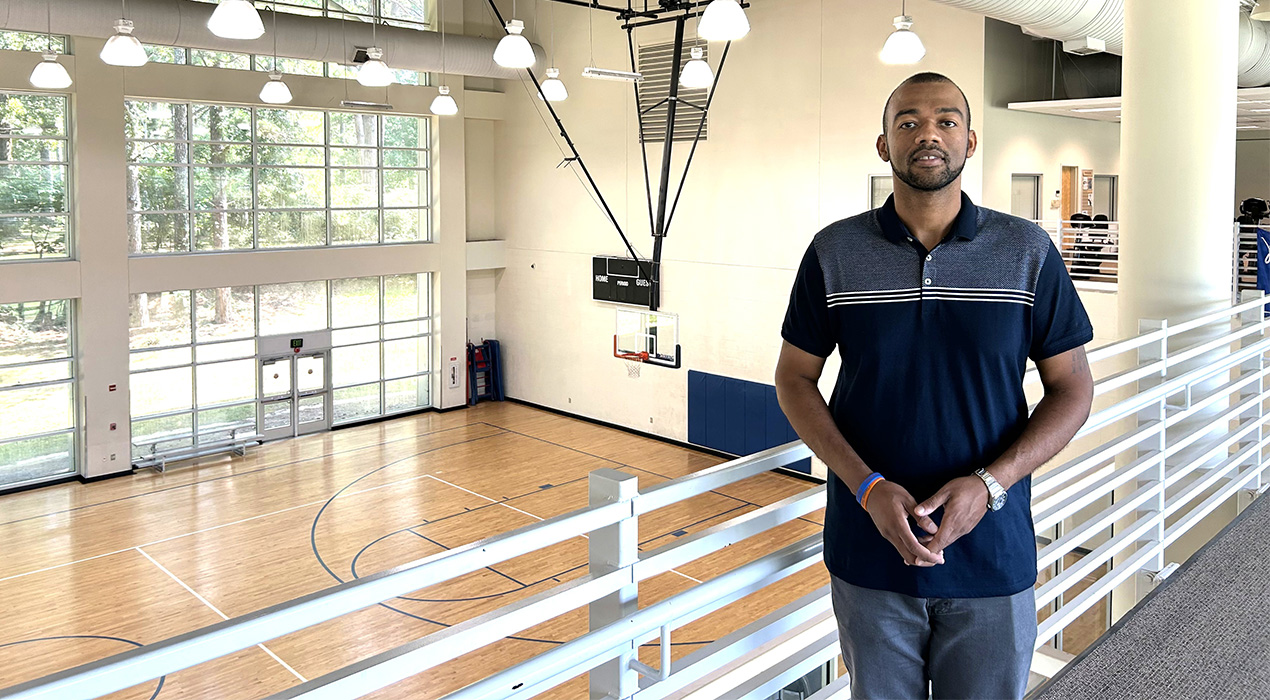
(July 13, 2026) - Dakarai Haughton transferred to Clayton State University in 2012 and graduated in the fall of 2015 with a degree in Communications, with a concentration in Media Studies. Now, a decade later, he serves as a Regional Admissions Counselor in the Office of Admissions and Recruitment, and he is among the first to greet prospective students as they explore the campus and navigate the admissions process.
Recently, Dakarai had the opportunity to tour the campus with a young man entering his senior year in high school and his two parents, who are alumni from the class of 2001. When they graduated 25 years ago, the institution was called Clayton College & State University. During the campus tour, the family visited the James M. Baker University Center. Construction for that building started shortly after the parents graduated on July 31, 2001.
The family also visited and was impressed by seeing the Student Activities Center, a hub for student activities, student organizations, programming and events, fitness, intramural sports, recreation, and student engagement, which first opened its doors to students on September 12, 2008.
The prospective student has already decided he is interested in the College of Business, whose current building opened on October 1, 2008. The high school senior is specifically interested in majoring in Supply Chain Management. That is a trending career, and Georgia is recognized as a hub for the supply chain and logistics industry. The state is home to the Port of Savannah, one of the largest and fastest-growing ports in the country.
The admissions counselor can relate to area high school students looking for a college in the Atlanta metro area. Born in Queens, New York, he grew up in Decatur, Georgia, and in Lithonia, which is now Stonecrest, Georgia. He attended Martin Luther King Junior High School in DeKalb County. Before transferring to Clayton State, he attended Georgia Perimeter College. Dakarai was searching for an affordable college in the Atlanta metro area when a family friend recommended Clayton State.
Dakarai understands that the lifestyle of attending classes on a college campus is much different than the high school experience. When he leads tours of the Clayton State campus he says, “students have an array of questions, but I would say the ones that I encounter the most are about our academic programs, the majors that they're interested in, locations of some of the classroom buildings, and where particular professors may be holding their lecture classes.” He added “they also have questions about our student clubs, our Greek letter organizations, or any other student activities that we do offer here.”
The parents Dakarai interacts with on tours evaluate the campus from a different viewpoint. He says, “Parents are more interested in learning about room and board, our residence halls, our meal plans, and then also our financial aid and scholarship opportunities. So more so from a financial perspective.” He noted that “parents will ask more of those deep dive questions in regard to those aspects of campus life.”
Dakarai says students he meets on campus tours share one thing in common when evaluating what Clayton State has to offer. “I would say a large percentage that I've interacted with have had a very solid plan coming in. So, from initial contact and our first conversations, I would say they all had a degree program and a major in mind.”
Once students and families understand that Clayton State offers the degrees and majors they want, Dakarai believes the main selling points are the campus environment and class sizes compared to other universities in large cities like Atlanta. “It's a very beautiful and picturesque campus. And I would say that that is one of the highest selling points for families. Then there is the information regarding our student-to-teacher ratio. Being a more mid-size institution gives students an opportunity to connect with professors and have more one-on-one time to help them achieve their academic goals.”