Federal Updates
2026 Federal Student Aid for College Students.
Recent federal student aid changes under H. R. 1 (the budget reconciliation bill passed by the 119th Congress and signed into law on July 4, 2025) introduce new federal student loan changes.
Most changes will begin July 1, 2026, with the start of the 2026-2027 aid year.
The Clayton State University Financial Aid office will continue to update this page as more federal guidance becomes available.
Who Is Affected by Federal Student Loan Changes?
These updates mainly affect students and families who will borrow federal loans on or after July 1, 2026, including:
- Students starting a new undergraduate or graduate program in 2026 or later,
- Students enrolled part-time and borrow federal loans,
- Families using Parent Plus Loans, and
- Graduate students who previously relied on Graduate Plus Loans.
Some enrolled may qualify for legacy provisions, allowing certain borrowers to continue under previous federal student aid rules for a limited period of time. Please note that the U.S. Department of Education will determine who is a legacy borrower for these provisions.
What Is Not Changing?
Some core federal aid programs will remain in place.
- Students must still complete the FAFSA each year to be considered for Federal and State funding.
- Federal Direct Loans will still be available to eligible students.
- The Federal Pell Grant is not being eliminated, but Pell Grant eligibility is changing.
Undergraduate Students
Loan Limits for Part-Time Students
Beginning July 1, 2026
Federal Direct Loan amounts will be based on the percentage of credits a student takes each term.
- Students enrolled full-time will be eligible for the full loan amount. Undergraduate students are considered full-time at 12 credit hours.
- Students enrolled part-time will have a reduced loan amount based on the enrolled credit hours.
Dropping or withdrawing from a course may reduce your loan amount.
Parent PLUS Loan Limits
Beginning July 1, 2026
New limits will apply to Federal Parent Plus loans for undergraduate students.
- Annual limit: Up to $20,000 per dependent student per award year (combined total if both parents borrow).
- Aggregate (lifetime) limit: Up to $65,000 per dependent student over time.
Legacy Provision for Parent Plus Loans: In some cases Parents who borrowed Parent PLUS loans before July 1, 2026, may be able to continue to borrow under current rules for up to 3 additional academic years or until the student completes their current degree, whichever occurs first. The U. S. Department of Education will determine who is a legacy borrower for these provisions.
Pell Grant Eligibility Changes
Beginning July 1, 2026
Eligibility rule change
- Students who have a Student Aid Index which is greater than twice the maximum Pell grant award will not be eligible for the Federal Pell Grant
Graduate Student Loan and Borrowing Changes
Loan Limits for Part-Time Students
Beginning July 1, 2026
Federal Direct Loan amounts will be based on the percentage of credits a student takes each term.
- Students enrolled full-time will be eligible for the full loan amount. Graduate students are considered full-time at 9 credit hours.
- Students enrolled part-time will have a reduced loan amount based on the enrolled credit hours.
Dropping or withdrawing from a course may reduce loan amount.
Graduate PLUS Loan Availability
Beginning July 1, 2026
Eliminated for new borrowers
- Graduate students who begin a new graduate program on or after July 1, 2026, will not have Graduate PLUS Loans available, even if they borrowed Graduate PLUS Loans in the past.
Federal Direct Unsubsidized Loan Limits for Graduate Students
Beginning July 1, 2026
Borrowing Limits have changed
Current limits (through June 30, 2026):
- Annual limit: Up to $20,500 per academic year.
- Aggregate (lifetime) limit: Up to $138,500, including federal loans borrowed for undergraduate study.
New limits (effective July 1, 2026):
- Annual limit: Up to $20,500 per academic year.
- Aggregate (lifetime) limit: Up to $100,000 (applies only to graduate-level borrowing; undergraduate loans are not included).
Previous Updates
Soft launch of the 2024-2025 FAFSA has begun; Clayton State will receive FAFSA data in March 2024
The Free Application for Federal Student Aid (FAFSA®) form for the 2024-2025 academic year is now available for access during the Federal Student Aid (FSA) "soft" launch. Details regarding the "soft" launch can be found through the Federal Student Aid website. Throughout this initial phase, the FAFSA form may be intermittently accessible as the FSA team closely monitors website performance and form functionality. Scheduled breaks for site maintenance and necessary technical updates have been planned to improve your user experience. If you submit your form during the soft launch, rest assured that your information will be securely saved, eliminating the need for resubmission or reentry of associated details. In case the form is temporarily unavailable during your attempt to access it, we recommend trying again at a later time.
FAFSA Simplification
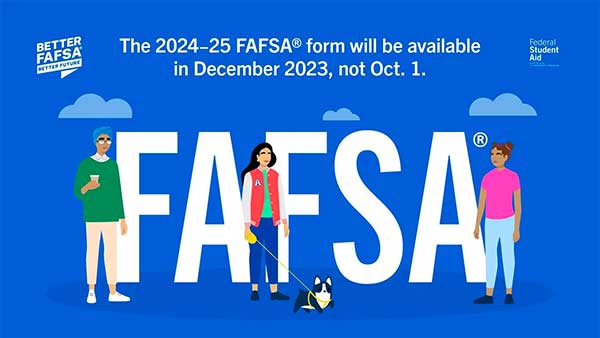
The FAFSA Simplification Act, passed on December 27, 2020, has brought about significant modifications to the Free Application for Federal Student Aid (FAFSA), slated to be implemented for the 2024-2025 aid year. This overview outlines the key changes and provides preparatory steps to facilitate a seamless application process. Stay tuned for updates to this page as more details emerge.
What does FAFSA Simplification entail?
The FAFSA simplification initiative marks a significant overhaul of the Free Application for Federal Student Aid (FAFSA®) process, representing the first major redesign in more than four decades. The primary objective is to streamline the application process, making it more accessible for students. In the upcoming 2024-2025 FAFSA, the number of questions will be reduced to approximately 37, a substantial decrease from the previous 100 questions.
What are the benefits of FAFSA Simplification?
- An application process that is more streamlined
- Increased eligibility for federal student aid
- Diminished obstacles for specific student groups (such as homeless and unaccompanied youth, incarcerated students, English language learners, and those from low-income backgrounds)
- Improved user experience when completing the FAFSA form
- Strengthened data sharing with the IRS to streamline the applicant's experience
How to Navigate the Changes
Notable adjustments to the application process encompass revisions to the FAFSA form, the application completion process for students and families, and modifications to the eligibility calculation.
The FAFSA form will be expanded to the 11 most common languages spoken by English learner students and their parents. Language-specific resources and support will also be available from FSA Information Center.
The form will be consumer-tested with prospective first-generation students and families, as well as students and families from low-income backgrounds.
The form will include new demographic questions about an applicant’s gender and race/ethnicity.
Rather than importing their tax information using the IRS Data Retrieval Tool, applicants will consent to providing their Federal Tax Information (FTI) via a direct data share with the IRS. This enhanced data sharing simplifies the applicant’s experience.
Eligibility for federal student aid will be expanded in the following ways:
-
- Selective Service and drug conviction questions will be eliminated to reduce applicant barriers.
- New methodology will be introduced to calculate and determine applicant The Expected Family Contribution (EFC) will be replaced with the Student Aid Index (SAI).
- The new need-analysis formula allows for a negative SAI calculation and implements separate eligibility criteria for Federal Pell Grants.
- Federal Pell Grant access will be expanded and linked to family size and federal poverty levels, which will allow more students and families from low-income backgrounds to qualify.
- Federal Pell Grant access will be restored to incarcerated students under specific rules and programs.
What's NOT Changing?
General types of federal aid and student loan limits remain the same.
Annual FAFSA submission is still required for federal aid consideration.
Dependency status questions that determine if your parent(s) must complete the FAFSA will remain the same.
Deadlines for submitting the FAFSA form each year will not change.
Tax information will still be requested from the prior-prior year. This means you will report your 2022 income and assets on your 2024-25 application.
Questions regarding an applicant’s sex, race, and ethnicity continue to be for statistical purposes and data collection only, with no impact on federal student aid eligibility. The school will not receive this data from the FAFSA.
Familiarizing yourself with revised and new FAFSA terms
| 2023-2024 and Prior Years Terminology | 2024 Terminology |
|---|---|
| EFC (Expected Family Contribution) | SAI (Student Aid Index) |
| FSA ID | FSA ID |
| Parent(s); Parent Spouse; Applicant Spouse | Contributors |
| IDR (Income Data Retrieval) | FTI (Federal Tax Information) and Consent |
| Room & Board | Housing & Food |
| Student Aid Report (SAR) | FAFSA Submission Summary |
Proactive Steps to Prepare NOW
1
Create your FSA ID on Federal Student Aid website
2
Assist contributors in creating an FSA ID
-
- Each student will be a contributor. Depending on the student’s family situation, you may need other contributors, such as a parent, spouse, or step-parent.
- The FAFSA form will guide you through questions to determine who needs to contribute information to your FAFSA. As part of your application, you will invite contributors to create an account and supply the required information.
3
Be ready to start and complete the FAFSA when it becomes available by January 1, 2024
-
- Mark your calendar! – we’ll update here and send an email once we know the official date that you can complete your 2024-2025 FAFSA.
- Check back often for updates – this is the biggest update to the FAFSA in 40 years! We will update here as more information becomes available.